


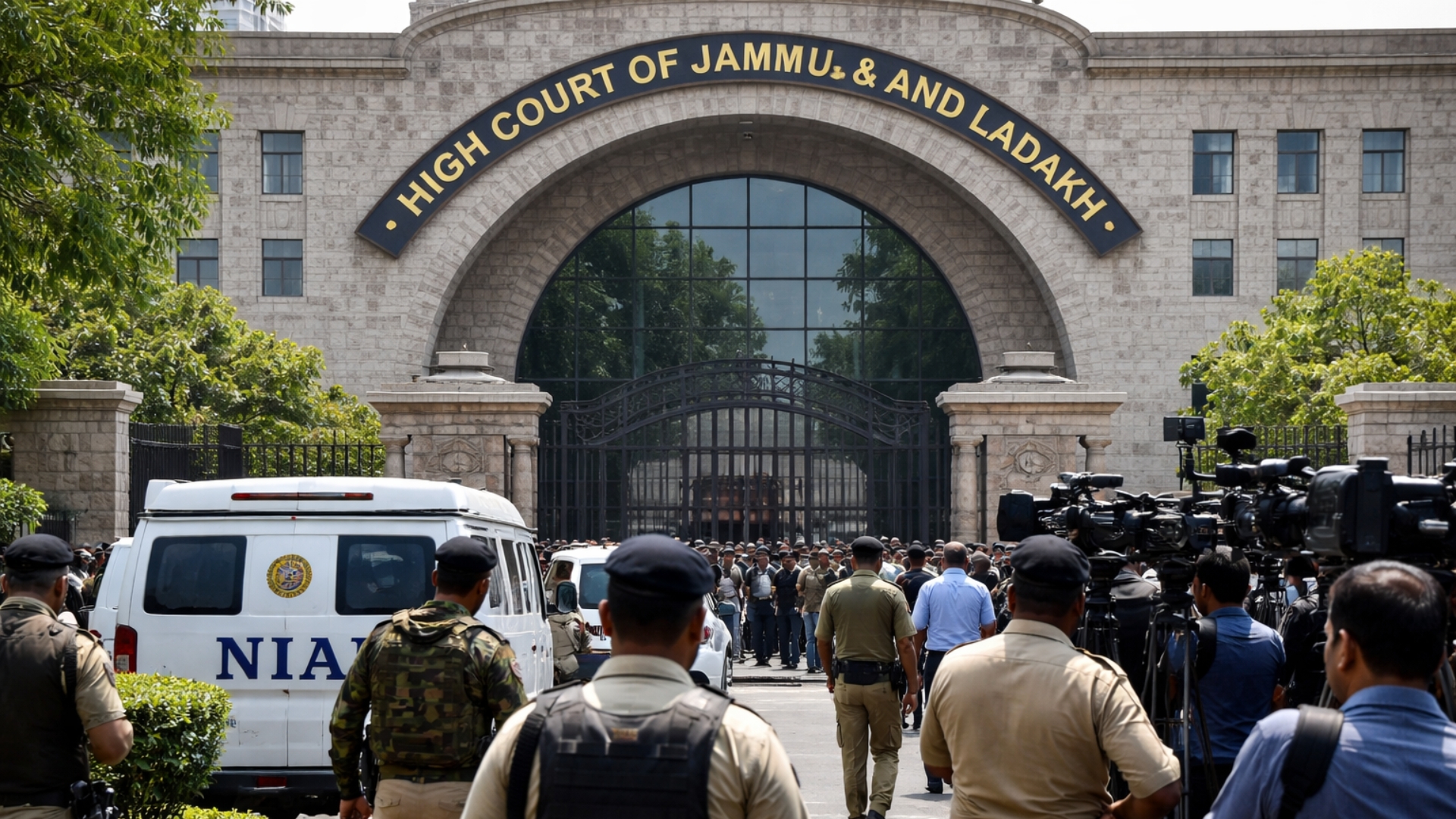
No Recovery, No Direct Role — Bail Granted in UAPA Case
Bench: Justice Sanjeev Kumar and Justice Sanjay Parihar
In a significant ruling dealing with the rigours of bail under the Unlawful Activities (Prevention) Act (UAPA), the High Court of Jammu & Kashmir and Ladakh set aside the Trial Court’s order refusing bail and granted relief to the appellant, emphasising that mere reliance on weak evidentiary material such as co-accused statements and approver testimony cannot sustain continued incarceration in the absence of corroboration.
The Division Bench underscored that while Section 43-D(5) of the UAPA imposes stringent conditions for grant of bail, courts are nonetheless duty-bound to assess whether the accusations are prima facie true on the basis of credible material. The Bench clarified that such satisfaction cannot be recorded mechanically and must reflect application of mind to the quality and probative worth of evidence presented by the prosecution.
Examining the record, the Court noted that the prosecution case rested predominantly on disclosure statements of co-accused and the statement of an approver, with no independent corroborative evidence such as recovery, financial trail, or direct involvement attributable to the appellant. The Bench observed that confessional statements of co-accused do not constitute substantive evidence and, at best, may lend assurance to other independent material which was conspicuously absent in the present case.
The Court further highlighted that the appellant had been in custody since March 2021, and despite the passage of considerable time, the prosecution had failed to establish any direct nexus between the appellant and the alleged recovery of narcotics or terror funding activities. The only specific allegation that the appellant facilitated the purchase of a truck later used in smuggling was found insufficient to infer participation in the larger conspiracy.
Importantly, the Bench reiterated settled principles governing criminal conspiracy, observing that mere association or knowledge does not amount to an agreement to commit an illegal act. There must exist cogent material demonstrating a meeting of minds, which was lacking in the present case.
On the interplay between prolonged incarceration and statutory restrictions on bail, the Court relied on constitutional principles under Article 21, holding that continued detention without substantial evidence and with no likelihood of early trial conclusion would be unjustified. The Bench reaffirmed that constitutional courts retain the power to grant bail even in UAPA cases where the prosecution case appears weak and custody becomes unduly prolonged.
Applying these principles, the Court concluded that the threshold under Section 43-D(5) UAPA was not met, as there were no reasonable grounds to believe that the accusations against the appellant were prima facie true. The absence of recovery, lack of direct involvement, and reliance on inherently weak evidence cumulatively weighed in favour of granting bail.
Accordingly, the impugned order denying bail was set aside, and the appellant was directed to be released on bail subject to conditions, including furnishing sureties, regular appearance before the Trial Court, and restrictions on movement outside the Union Territory without permission.
Case Details
Case Title: Amin Allaie v. National Investigating Agency
Court: High Court of Jammu & Kashmir and Ladakh at Jammu
Case Number: Crl A(D) No. 26/2025
Judgment Date: 02 April 2026
Bench: Justice Sanjeev Kumar and Justice Sanjay Parihar
Statutes Involved:
Section 120-B IPC
Sections 8/21 NDPS Act
Sections 17, 18, 20, and 43-D(5) UAPA
Disposition: Bail Granted; Trial Court order set aside