


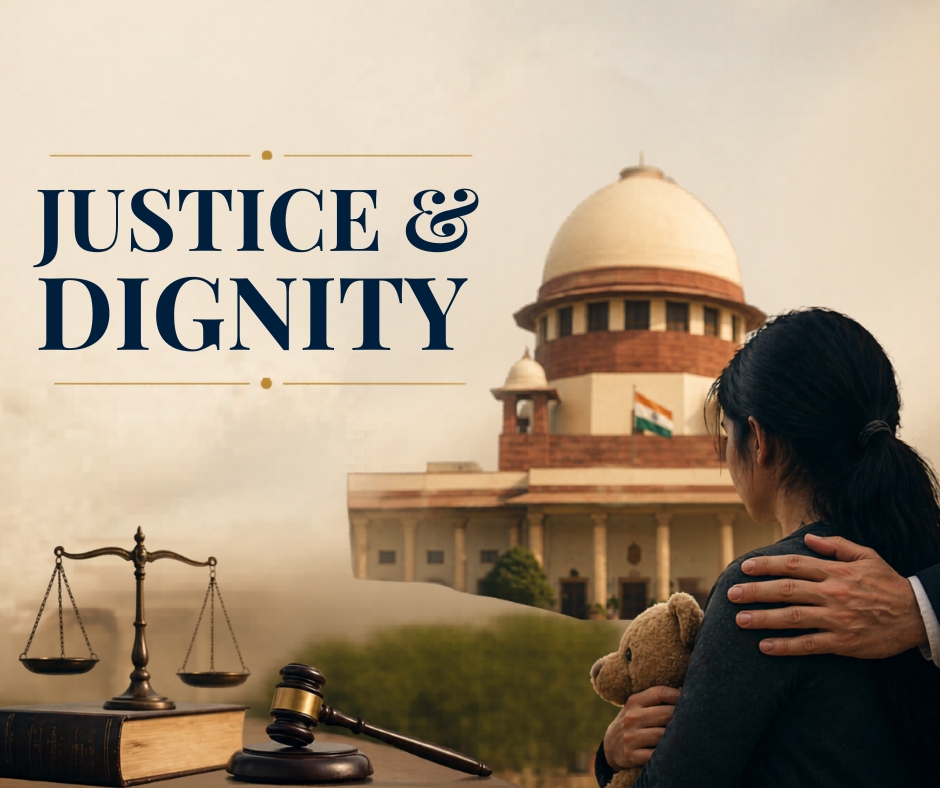
Minor Rape Survivor’s Choice Cannot Be Overridden by State or Medical Authorities
Bench: Chief Justice of India Dhananjaya Y. Chandrachud, Justice Surya Kant and Justice Dipankar Datta (as per hearing context)
In a significant and deeply empathetic hearing, the Bench of the Supreme Court of India strongly reaffirmed the primacy of a minor rape survivor’s autonomy, dignity, and mental well-being while dealing with a curative petition challenging the termination of an advanced-stage pregnancy. The Court made it unequivocally clear that neither the State nor medical authorities can override the informed choice of a victim, particularly in cases involving severe trauma and reproductive rights.
At the outset, the Bench, led by the Chief Justice of India, sharply questioned the attempt by the State and medical authorities to compel a 15-year-old rape survivor to carry an unwanted pregnancy to term. The Court underscored that forcing a minor who ought to be engaged in education and personal development into motherhood against her will would constitute a grave violation of her dignity and bodily autonomy protected under Article 21 of the Constitution.
The Court engaged extensively with the tension between the rights of the foetus and the rights of the minor survivor, ultimately holding that the law must take a holistic view of the victim’s life and future. In a powerful observation, the Court remarked that the law, when required, must be “ruthless” to ensure justice, especially where the lifelong trauma, stigma, and psychological burden on the survivor far outweigh uncertain medical projections regarding the foetus.
Addressing submissions made by Additional Solicitor General Aishwarya Bhati, appearing for the All India Institute of Medical Sciences (AIIMS), the Court expressed concern over the institutional stance that sought to prioritize medical feasibility over the survivor’s choice. The ASG had argued that termination at 30 weeks would be medically complex, potentially resulting in a live birth with severe deformities and long-term complications for the minor. It was further submitted that the procedure may involve foeticide and could jeopardize the minor’s reproductive health, suggesting instead that the pregnancy be carried forward to facilitate adoption.
Rejecting this approach, the Bench emphasized that medical expertise, while crucial, cannot substitute or override the will of the patient. The Court observed that “specialized knowledge of medical professionals cannot become the master of the will of the people,” reiterating that doctors are advisors, not decision-makers. It cautioned against a paternalistic “parens patriae” approach, where the State assumes control over personal decisions instead of enabling informed choice.
Justice Bagchi, concurring with the Bench, criticized the State’s stance as overly intrusive, noting that the role of the State is to provide information and support not to impose decisions. The Court directed that the minor and her parents be furnished with complete medical data and provided psychiatric counselling, but firmly maintained that the ultimate decision must rest with them.
The Bench also declined to entertain the curative petition filed by the State through AIIMS, observing that such extraordinary remedies should not be invoked by the State to override a judicial determination made in the interest of a vulnerable citizen. It clarified that if any curative plea were to be considered, it ought to emanate from the affected parties themselves namely, the minor or her guardians not from the State.
Importantly, the Court also used the occasion to recommend legislative reform. It urged the Government to revisit the Medical Termination of Pregnancy Act, 1971 and consider removing gestational limits in cases involving rape of minors. The Bench emphasized that rigid statutory timelines should not stand in the way of justice in such exceptional circumstances. Additionally, it suggested that trials in such sensitive cases be expedited and concluded within a week to prevent prolonged trauma for victims.
The Court also contextualized the broader societal realities, observing that while there is considerable focus on the potential life of the foetus, insufficient attention is paid to the plight of children already born and abandoned. The Bench noted the prevalence of child trafficking and the existence of numerous children in need of care, questioning the disproportionate emphasis on uncertain foetal outcomes in comparison to the lived suffering of the survivor.
This hearing follows the Court’s earlier order dated April 24, 2026, wherein a Bench of Justice B. V. Nagarathna and Justice Ujjal Bhuyan had permitted the medical termination of the 30-week pregnancy, holding that compelling the minor to continue the pregnancy would amount to a violation of her reproductive autonomy and right to live with dignity. The Court had given primacy to her mental health and bodily integrity over statutory restrictions.
Subsequently, a review petition filed by AIIMS was dismissed on April 29, 2026, with the Court observing that the institute appeared to be challenging a judicial mandate rather than complying with it. The present curative petition was also dismissed, with the Court reiterating that constitutional rights cannot be curtailed by procedural or medical objections when fundamental dignity and autonomy are at stake.
Case Details
Case: Minor Rape Survivor Pregnancy Termination Case
Court: Supreme Court of India
Coram: CJI D.Y. Chandrachud, Justice Surya Kant, Justice Dipankar Datta (hearing bench context)
Earlier Bench: Justice B.V. Nagarathna & Justice Ujjal Bhuyan
Date of Orders: April 24, 2026 (Final Order); April 29, 2026 (Review Dismissed); Curative Petition Dismissed thereafter
Key Statute: Medical Termination of Pregnancy Act, 1971
Disposition: Curative Petition Dismissed; Termination Allowed